The traditional dress for kids in India changes with every state: pavadai sattai and veshti in Tamil Nadu, kasavu pattu pavada and mundu in Kerala, langa voni and pancha in Andhra and Telangana, chaniya choli and kediyu in Gujarat, salwar kameez and kurta pyjama in Punjab, and mekhela chador in Assam. For school traditional day, pick the outfit your family actually wears or the state your child has been given, then choose the kid-friendly version: soft lining, an elastic or velcro waist and nothing that trips them on stage.
That's the short answer. Below is the long, useful one, with a girls vs boys table, honest notes on what's easy to buy in a child's size, and a checklist for the morning of the event.
What do kids wear in each Indian state? (Quick table)
| Region | Girls | Boys | Easy to find in kid sizes? |
|---|---|---|---|
| Tamil Nadu | Pavadai sattai (pattu pavadai), half saree for older girls | Veshti with shirt, optional angavastram | Very easy |
| Kerala | Pattu pavada in kasavu (off-white with gold border) | Kasavu mundu with shirt or jubba | Easy, especially around Onam |
| Karnataka | Langa davani or silk langa | Panche with shirt, Mysore peta for stage | Easy for langa; peta is a costume shop find |
| Andhra Pradesh / Telangana | Langa voni (pattu langa with blouse and voni) | Pancha with kurta or shirt | Easy |
| Maharashtra | Pre-stitched nauvari, or a paithani-style silk langa | Kurta pyjama or dhoti with Nehru jacket, pheta | Moderate |
| Gujarat | Chaniya choli | Kediyu with chorno or dhoti | Easy around Navratri, harder off-season for boys |
| Rajasthan | Ghagra choli with odhni | Angrakha or kurta with dhoti, safa | Moderate |
| Punjab | Salwar kameez or patiala with phulkari dupatta | Kurta pyjama, patka or turban | Very easy |
| West Bengal | Red and white laal paar saree (pre-draped for kids) | Dhoti with panjabi (kurta) | Moderate |
| Assam | Mekhela chador | Dhoti, kurta and gamosa | Hard outside the North-East |
| Odisha | Sambalpuri-style frock or langa | Dhoti with kurta | Moderate |
| Kashmir | Pheran (long loose tunic) | Pheran with pyjama | Hard outside Kashmir |
Which South Indian traditional dresses suit kids best?
This is our home turf, so we'll be specific.
 Design GPP269B, a salmon pink and yellow pattu pavadai: Tamil Nadu's classic, in a toddler size.
Tamil Nadu. Girls wear the pavadai sattai: a long silk or cotton skirt (pavadai) with a matching blouse (sattai). Teen girls often move to the pavadai dhavani, where a half saree drapes over it. Boys wear a veshti, usually white or cream with a zari border, with a shirt in silk or cotton. For little ones, a ready veshti with velcro or an elastic waist beats a free-tie one every single time.
Our pattu pavadai collection covers the girls' side, and boys can choose from veshti and dhoti pieces or complete shirt and dhoti sets. For a deeper dive, read why the pattu pavadai is underrated and our veshti for boys size guide.
Kerala. The look everyone recognises is kasavu: off-white cotton with a gold border. Girls wear a pattu pavada (Kerala's name for the long skirt and blouse), and boys wear a kasavu mundu with a shirt or short jubba. It's the go-to for Onam, and also for "Kerala" on unity day. Look for off-white and gold styles in pattu pavadai and veshti ranges.
Karnataka. Girls wear a langa davani, similar to the half saree, or a silk langa for younger kids. You'll often hear Ilkal and Mysore silk mentioned, but these are mainly adult sarees. A kid can carry the idea with a silk langa in deep red, green or mustard, rather than a full Ilkal drape. Boys wear a panche (dhoti) with a shirt, and a Mysore peta (turban) if it's a stage event.
Andhra Pradesh and Telangana. Girls wear langa voni: a langa (skirt), blouse and a voni (half saree). Pochampally ikat and Gadwal-style silk are the regional favourites. Boys wear a pancha with a kurta or shirt. A pattu pavadai with a contrast dupatta pinned like a voni is a quick, comfy version for small girls.
What about North, West and East India?
Maharashtra. Girls traditionally wear the nauvari (nine-yard saree), with a nath (nose ring) for festivals. For kids, buy it pre-stitched; draping nine yards on a wriggly six-year-old is a sport nobody wins. Boys wear a kurta with pyjama or dhoti, a Nehru jacket and a pheta (turban). Nesavu doesn't make nauvari sets. A close alternative is a silk pattu pavadai in paithani-style colours like peacock green or purple with a contrast border.
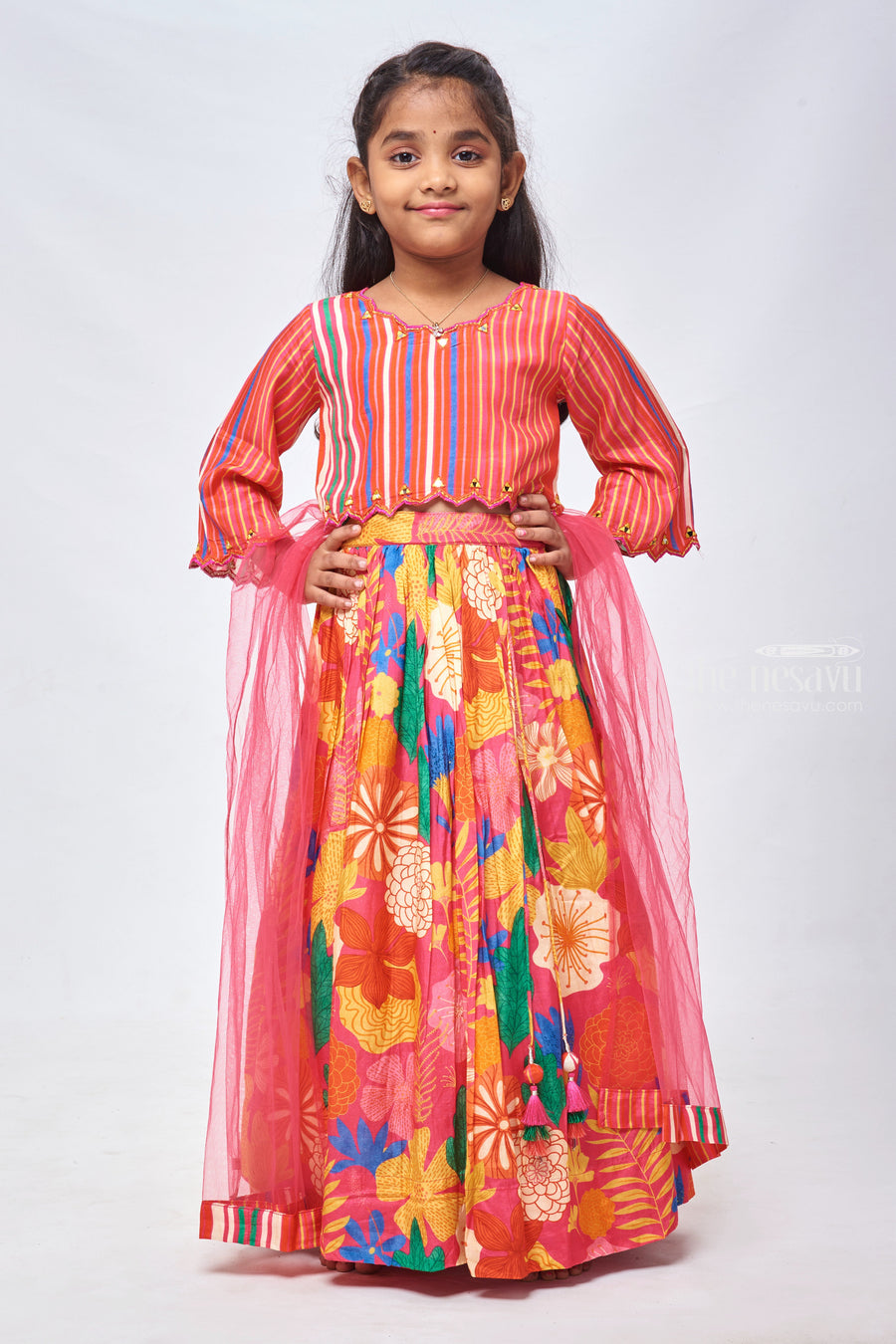
Gujarat. Girls wear the chaniya choli, especially for Navratri garba. Boys wear the kediyu, a short frilled top, with a chorno or dhoti. Our lehenga and ghagra collection works well for the girls' look. We don't sell kediyu, so for boys a kurta-style shirt with a dhoti set and a bright bandhani-print stole is a fair swap.
 Design GL399A, a bandhej lehenga choli that reads Gujarat or Rajasthan from the back row.
Rajasthan. Girls wear a ghagra choli with an odhni, often with mirror work or gota. Boys wear an angrakha or kurta with dhoti and a colourful safa (turban). A lehenga with a dupatta draped over the head reads as "Rajasthan" instantly on stage.
Punjab. Girls wear salwar kameez or patiala salwar with a bright phulkari dupatta. Boys wear kurta pyjama with a patka or turban. This is one of the easiest costumes to find anywhere in India. We don't sell salwar sets; an anarkali with a phulkari-style dupatta is the closest Nesavu-style option.
West Bengal. Girls wear the white saree with a red border (laal paar), especially during Durga Puja. For kids, choose a pre-draped saree or a cream frock with a red border. Boys wear a dhoti with a panjabi (Bengali kurta). Our boys' dhoti sets with a cream or white kurta-style top get you most of the way there.
Assam and the North-East. Girls wear the mekhela chador, a two-piece drape often in muga or eri silk. Boys wear a dhoti and kurta with a gamosa (the white and red woven towel) around the neck. Nesavu doesn't stock these, and they're genuinely hard to buy in kid sizes outside the region. Your best bet: ask a friend from Assam, check regional handloom stores, or pair a cream silk frock with a red-bordered stole for girls and a white kurta, dhoti and gamosa for boys.
What should kids wear for North Indian festivals and functions?
Plenty of our orders come from families who celebrate Lohri and Holi, not only Pongal and Onam. We ship these to families from Delhi to Singapore, so here's the quick version for each occasion.
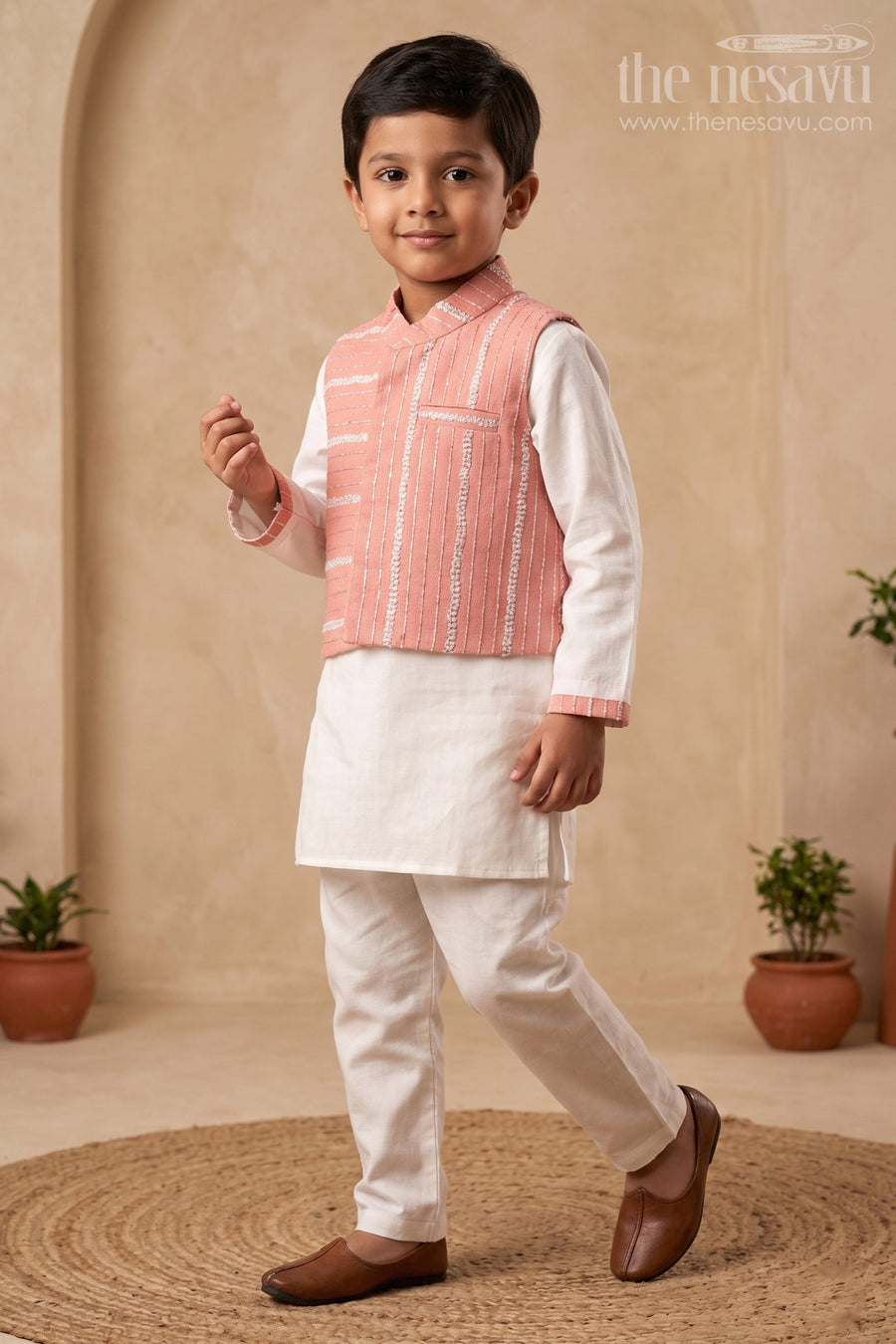
 Design BES585B, a kurta and dhoti with a Nehru jacket: festival-ready, North or South.
| Occasion | Girls | Boys | Nesavu pick | Practical tip |
|---|---|---|---|---|
| Diwali (Oct/Nov) | Lehenga choli, sharara or anarkali | Kurta set with a jacket | Girls' ethnic wear, boys' ethnic wear | Skip loose dupattas and long net layers near diyas and sparklers |
| Navratri / garba (Sep/Oct) | Lehenga choli with a full flare | Kurta with dhoti | Navaratri edit | Ankle length, light fabric: nine nights of twirling is a lot of twirling |
| Holi (Mar) | Simple cotton co-ord | Cotton kurta set | Girls' clothing sets | Wear old cotton for the colour play; save the new outfit for the evening |
| Raksha Bandhan (Aug) | Sharara set or frock | Cotton kurta set | Girls' sharara sets, boys' kurta sets | August is humid, so cotton beats silk for a long day of visits |
| Lohri (13 Jan) | Anarkali or sharara with sleeves | Kurta with a jacket layer | Boys' jacket sets | Layers for the bonfire chill, and keep dupattas and flared hems well away from the flames |
| Eid (date moves with the moon) | Sharara or anarkali | Kurta set or sherwani | Girls' anarkalis, boys' sherwanis | Check the season the date falls in: summer Eid means cotton |
| Winter weddings (Nov-Feb) | Fancy lehenga or sharara | Jacket set, sherwani or blazer set | Girls' fancy lehenga, boys' jacket and blazer sets | Pick sleeves, a lined skirt and pack a shawl for evening pheras and the baraat |
How do I pick a comfortable traditional dress for school events?
Kids will be wearing this for four to six hours, sitting on floors, climbing stairs and running to the bathroom. Comfort wins.
- Choose cotton or soft-lined silk. Pure silk without lining can feel scratchy, and synthetic fabric traps heat under stage lights.
- Pick ready-to-wear over drapes. Pre-stitched sarees, velcro veshtis and elastic-waist dhotis mean no mid-event unravelling.
- Check skirt length. A pavadai or lehenga should end at the ankle, not the floor. Floor-length is how kids trip on stage steps.
- Watch the neckline and sleeves. Heavy zari collars rub. Soft piping is kinder for long days.
- Skip loose bits for little ones. Dangling tassels, loose beads and cords near the face are a no for toddlers.
- Do a toilet test at home. If your child can't manage the outfit alone, the school teacher can't manage 30 of them either.
What's the smartest way to handle "traditional day" at school?
School notices often land with only a few days to spare. A few things that help:
- Confirm the brief. Is it "your own culture" or "an assigned state"? It changes everything.
- Order ready stock, not made to order. Everything at Nesavu ships from ready stock, and orders placed before about 2 PM are usually dispatched the same day, typically within 1 to 3 business days. Those are regular timelines; festive and sale rushes can stretch them by a few days.
- Size up if between sizes. Check the Nesavu size chart, measured in inches, and go one size up if your child is between two. Orders in India have a 7-day exchange window if the fit is off (international orders can't be exchanged through us, so confirm the size on WhatsApp first).
- Pack a backup kit. Safety pins, a small towel, a spare inner, a hair tie and the school's regular shoes.
- Mind the weather. Kerala kasavu in May heat is lovely; full Rajasthani layers in Chennai humidity, less so.
- Let them choose a colour. A kid who picked their own outfit actually keeps it on.
Can one outfit work for traditional day, festivals and weddings?
Yes, and this is where your money goes further. A silk pattu pavadai works for traditional day, Pongal, Diwali and a family wedding. So does a boys' silk shirt and veshti set. For girls who want something that works beyond South Indian events, a lehenga or a silk frock pairs with a dupatta for traditional day and then without it for birthday parties. If there's a wedding on the calendar too, browse The Wedding Edit for both.
FAQ
What is the traditional dress for kids in Tamil Nadu? Girls wear the pavadai sattai (pattu pavadai), a long skirt with a matching blouse, and older girls wear the half saree. Boys wear a veshti with a shirt, often silk for festivals.
What should my child wear for unity in diversity day at school? Wear the outfit of the state your child is assigned, or your family's own region. Ready-made options like a lehenga (Gujarat or Rajasthan), pattu pavadai (Tamil Nadu), kasavu (Kerala) and kurta pyjama (Punjab) are the easiest to find quickly.
What is the easiest traditional dress for boys? A ready shirt and dhoti or veshti set with a velcro or elastic waist, or a simple kurta pyjama. Both are quick to put on, easy to sit in and available in most kid sizes.
What is the Kerala traditional dress for kids during Onam? Girls wear a kasavu pattu pavada in off-white with a gold border, and boys wear a kasavu mundu with a shirt or short jubba.
Is silk comfortable for kids for a full school day? Silk with a soft cotton lining is generally comfortable. Unlined silk can feel scratchy, so for long or hot days, cotton or a silk-cotton blend is a safer pick.
What if the costume I need isn't sold in kid sizes? Use a close swap: a pre-stitched or pre-draped version, a silk langa instead of an adult saree, or the region's key colours and one signature piece such as a gamosa, phulkari dupatta or turban.
How quickly can I get a Nesavu outfit before a school event? Everything is ready stock, and orders before about 2 PM are usually dispatched the same day, with dispatch typically within 1 to 3 business days. For last-minute help with sizes, WhatsApp us on +91 80989 91122.
Traditional day sorted? Pick the pavadai, veshti or lehenga and add to cart before your size disappears (again 😅).