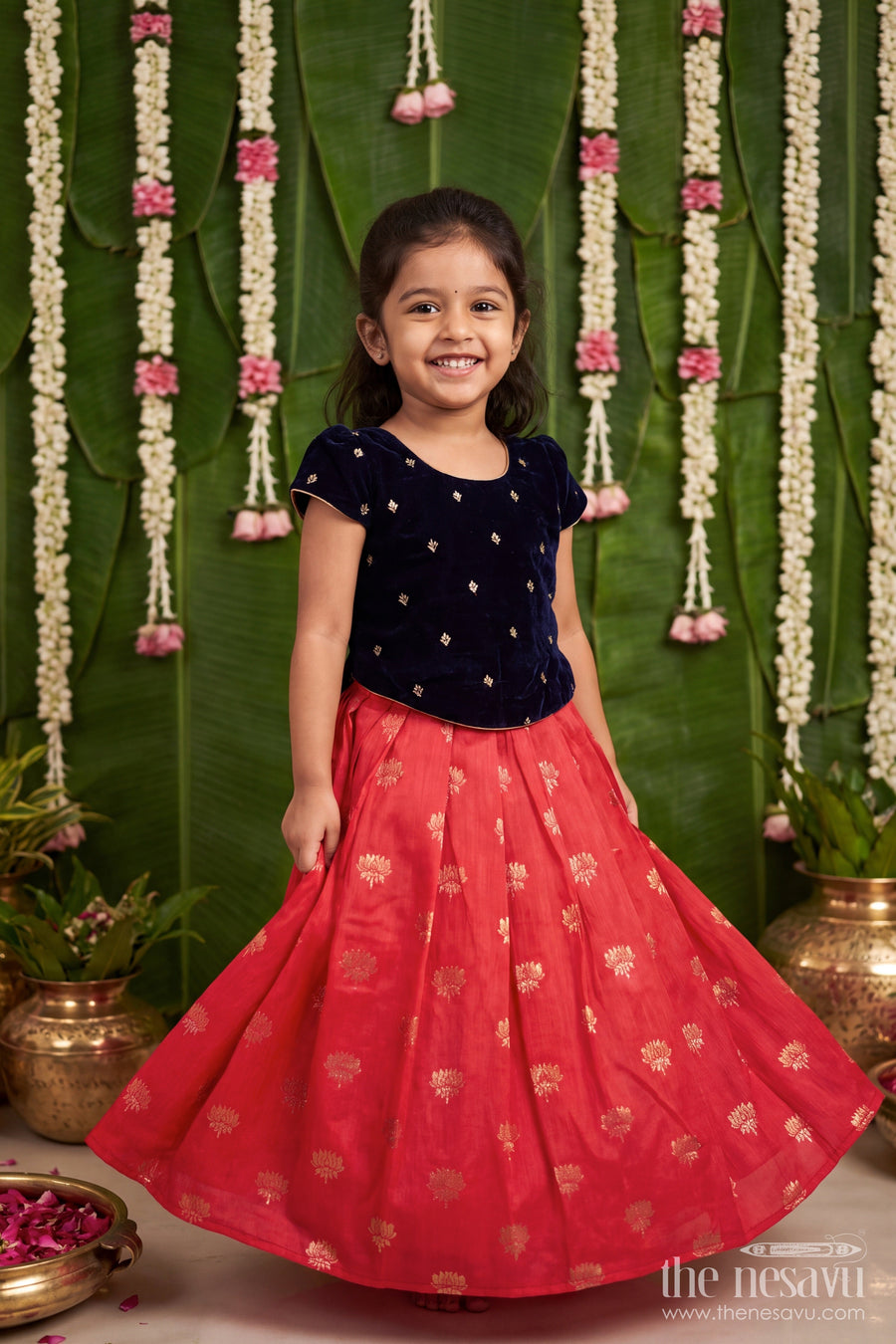
Quick answer: Pattu pavadai is the traditional South Indian silk skirt and blouse set that girls wear for festivals, temple visits and family functions. Telugu and Kannada families call it pattu langa, and Kerala calls it pattu pavada. When a third piece, the voni or davani, is added for older girls, it becomes a half saree, also called langa voni or langa davani.
What is a pattu pavadai?
The pavadai, also called the langa, is a long, crisply pleated, cone-shaped silk skirt that falls from the waist to the toes, usually with a contrast zari border at the hem. It is worn with a sattai or choli, a blouse cut to fit the body. Today you will see many neckline and sleeve styles, from simple short sleeves to puff sleeves and peplum tops.
How it fastens depends on her age. For younger girls, up to about 12 years, an authentic pattu pavadai comes stitched onto a soft, lined bodice, so the skirt hangs from her shoulders and there is no waistband pressing on her tummy. For teens and older girls, the skirt is tied at the waist with a thread (naada), or sometimes closed with a hook. A North Indian lehenga, by contrast, usually comes with an elastic waist and a separate top.
What it is called across South India
- Tamil: பட்டுப் பாவாடை (pattu pavadai), or pavadai sattai with the blouse
- Malayalam: പട്ടുപാവാട (pattu pavada)
- Telugu: పట్టు లంగా (pattu langa), also pattu parikini
- Kannada: ರೇಷ್ಮೆ ಲಂಗ (reshme langa), also pattu langa
The half saree has its own names: langa voni in Telugu (లంగా వోణీ), pavadai dhavani in Tamil (பாவாடை தாவணி) and langa davani in Kannada (ಲಂಗ ದಾವಣಿ).
Pavadai, davani and the half saree
A full half saree has three parts: the langa or pavadai, the blouse, and a voni, oni or davani, which is a length of fabric of about two to two and a half metres. The voni is wrapped diagonally over the blouse, which is why the set is also known as a half saree or two-piece saree. It is traditionally worn by teen girls between puberty and marriage, while younger girls wear the two-piece pattu pavadai. The ghagra choli of North India is a close cousin. The main difference is the direction in which the dupatta or voni is draped.
When do girls wear it?
- The naming ceremony, or namakaran
- The first rice feeding, or annaprashana
- Temple visits and pooja at home
- Festivals such as Diwali, Pongal and Onam
- Weddings and family functions
- Coming of age ceremonies
In many South Indian families, at a coming of age ceremony the girl wears a half saree from her maternal grandparents for the first part of the function, and then her first saree from her paternal grandparents for the second part. It marks her step into a new stage of life. The lehenga-style saree many Indians wear for celebrations today is inspired by the langa voni.
Choosing a pattu pavadai for your child
- Check the lining. A soft cotton lining on the bodice keeps silk from scratching and lets her skin breathe.
- Skip the elastic for little ones. For girls under about 12, pick a pavadai stitched onto a lined bodice. Nothing grips her tummy, so she can sit, run and eat comfortably through a long function. For teens, a thread tie or hook lets you adjust the fit.
- Pick a size with room. Children grow fast, so a little room means more wear from one outfit.
- Keep the blouse comfortable. Choose soft edges and easy fastenings so your child does not tug at it all day.
- Plan the day. A heavy border and a long function call for a lighter skirt. A short ceremony can handle more shine.
Browse our pattu pavadai collection for girls, from babies to older children, and see baby welcome and naming ceremony outfits if you are planning a first function. Our free Festival Outfit Planner helps you plan every look in one place.
Frequently asked questions
What is the difference between pattu pavadai and lehenga?
A pattu pavadai is a crisply pleated, cone-shaped silk skirt. For younger girls it is stitched onto a lined bodice, and for teens it ties at the waist with a thread or hook. A lehenga is usually more flared, has an elastic waist and a separate top, and is worn with a dupatta.
Is a half saree the same as a pattu pavadai?
They are closely related. A half saree (langa voni or pavadai dhavani) is a pavadai set with an added voni or davani draped over the blouse. The pattu pavadai without the voni is the two-piece version younger girls wear.
At what age can a girl wear a pattu pavadai?
Girls of almost any age can wear one. Many families dress babies in a pattu pavadai for the naming ceremony or first rice feeding, and girls continue to wear it for festivals and functions as they grow.